
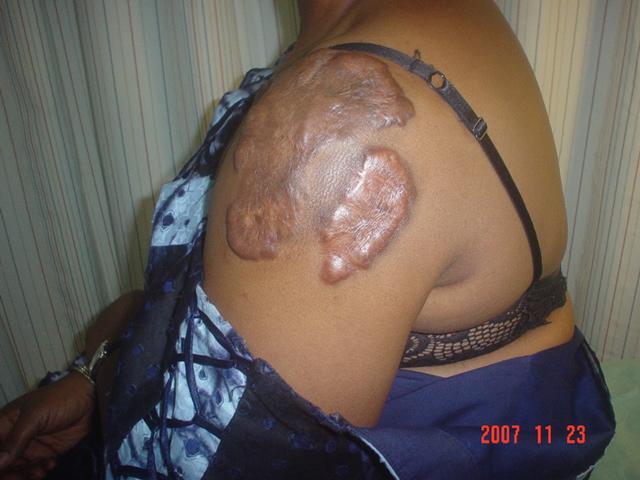
Unlike lower animals human beings don’t regenerate parts once lost. Similarly they don’t regenerate tissues once damaged. Healing or repair occurs through a process called scarring. This simply means that the body mobilizes a protein called collagen which forms the matrix needed by the body to plug and repair the damaged tissues.
Science has shown that for some inexplicable reason, the darker the skin colour the more robust this scarring process can be. There seems to be a positive association between the concentration of melanin producing cells in the skin and the scarring process. Coloured races like the Asians or South Americans, scar more than Caucasians, although blacks scar more than them.
Two types of scar exist. Hypertrophic scars and Keloidal scars. Whereas Hypertrophic scars can be found on all skin colours, keloidal scars tend to happen in blacks and to a lesser extent, on coloured skin people. There has been some hereditary factors in the development of keloids. So it tends to run in families. Fortunately the Hypertrophic scars tend to be self limiting, having a life span of months during which they mature, flatten, get more supple, paler and also less symptomatic. It is at this time that Plastic surgeons can intervene and improve on the scars through a surgery called Scar revision. Sometimes no surgery might be necessary.
Keloidal scars on the other hand, may follow very minor injuries or even mere insect bites. They could even follow recovery from skin rash infections. These scars are not self limiting, they continue to grow for life, although they may have periods of remissions. They could be very symptomatic with severe itch and pains. They may also be disfiguring, producing altered body images, especially when they occur in areas of exposed anatomy. Some of them may be complicated by recurrent pus producing skin infections. This is quite common with keloids around the beard area. Research on keloid treatment has been quite slow because it is difficult to re-create it in experimental animals, as they don’t form keloids. Consequently there is no promise of recurrent free treatment by attending Plastic surgeons. Till date there is no one regime that can guarantee a permanent cure of keloidal scars, although some carefully executed techniques may bring about a permanent cure in a large percentage of patients so treated………(to be continued in Part 2)
Good Evening sir ,
Excellent blog . Good start sir . I will be glad to learn here and also contribute.
I hope there will be opportunities to ask for your experts opinion on related matters .
Permission to share this site address with othe4s
Thanks very much Dr Amusa. You have my permission to share my website pls.
More blogs to follow soon.